


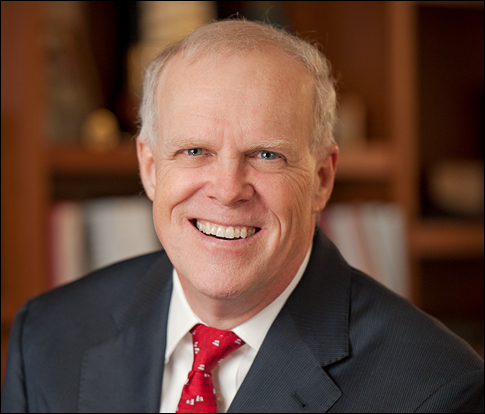

John L Hennessy 
For pioneering a systematic, quantitative approach to the design and evaluation of computer architectures with enduring impact on the microprocessor industry.
John L. Hennessy, born in 1952, was raised on Long Island’s north shore in Huntington, New York. His mother was a teacher before retiring to raise six children; his father was an electrical engineer. He was a tinkerer in high school, winning a science fair prize for an automated tic-tac-toe machine. This impressed the mother of his senior prom date, Andrea Berti, a girl he knew from his shelf-stocking job at the local King Kullen grocery store. He enrolled at Villanova University near Philadelphia, earning a bachelor’s degree in electrical engineering (1973). For graduate school, he returned to Long Island, attending Stony Brook University (then S.U.N.Y. Stonybrook), married Andrea in 1974, and garnered a master’s (1975) and Ph.D (1977) in computer science.
Hennessy became an Assistant Professor at Stanford in September, 1977, remaining for virtually his entire career. Coincident with his first major honor, the John J. Gallen Memorial award by Villanova in 1983, he became an Associate Professor at Stanford. In 1986 he became the inaugural holder of the Willard and Inez Kerr Bell endowed chair.
His work centered on computer architecture. In 1980, microcomputers were rapidly advancing in complexity, to challenge the capabilities of minicomputers. The prevailing wisdom was that powerful processors needed very large, very rich instruction sets. As Hennessy observed in his Turing award lecture, “Microcomputers were competing on crazy things like here’s my new instruction to do this kind of thing … rather than saying here’s a set of standard benchmarks, and my machine is faster than your machine….”[1]
Hennessy won fame by challenging this mindset with his work on reduced instruction set computer architectures (RISC), along with David Patterson, a Berkeley professor. They first met at a microprocessor conference in 1980 where each was presenting similar micro-coding concepts. Hennessy recalled that “like Dave at Berkeley, we started with a clean slate with our graduate student class that was sort of a brainstorming class. We had a unique perspective. People were ignoring basic performance implications completely. It was an efficiency argument from the very beginning…. We both built prototypes of our design, and we could see that the advantages were clear. These were academic prototypes built by graduate students.”
Building on the original RISC work of John Cocke at IBM, in 1983, Hennessy’s Stanford team developed a prototype chip named MIPS (Microprocessor without Interlocked Pipeline Stages). The first MIPS chip used 25,000 transistors and ran at a slightly faster clock speed than a similar Berkeley chip called RISC-2 (40,760 transistors).[2] To advance and commercialized this technology he co-founded MIPS Computer Systems in 1984, during a sabbatical from Stanford. He served eight years as their chief scientist, and six more as chief architect. MIPS was later acquired by Silicon Graphics, where its processors, combined with custom graphics developed by James Clark at Stanford, powered the high-performance graphics workstations relied on by Hollywood in the late 1980s and 1990s.
Patterson recalled that: “There is this remarkable point in time when it was clear that a handful of grad students at Berkeley or Stanford could build a microprocessor that was arguably better than what industry could build—faster, cheaper, more efficient…. RISC was very controversial, it was heretical… and John and I were on the RISC side while all the other people were on the CISC side…. We had a hard time convincing people of that.” [3]
While others argued about the relative merits of the Hennessy and Patterson variants of RISC, they recognized that the much larger contest was between RISC ideas embodied in both of their chips versus the CISC (Complex Instruction Set Computing) architectures then used throughout the industry from mainframes to personal computers. The two began a partnership, creating a systematic quantitative approach for designing faster, lower power and reduced complexity microprocessors, co-authoring two books that became landmark textbooks for the discipline. The first, Computer Architecture: A Quantitative Approach, now in its sixth edition, established enduring principles for generations of architects. [4]
Patterson quantified the impact of this work in his Turing lecture, given jointly with Hennessy: “Our colleagues at Intel … had great technology…. They got up to 350 million chips per year, not only dominating the desktop, but servers as well…. But the Post-PC era, starting with the iPhone in 2007 totally changed things… valuing area and energy as much as performance. Last year there were more than 20 billion chips with 32-bit processors in them. [Intel compatible] chips peaked in 2011 with dropping sales of PCs, and there are only 10 million chips in the cloud, so 99% of the processors today are RISC.” [5]
Hennessy’s career at Stanford led him from research to administrative leadership. Within five years of becoming department chair in 1994 he was appointed Provost, working with his former colleague, Jim Clark (founder of Silicon Graphics) to arrange a record-setting donation to create a biological engineering and sciences center. Clark said of Hennessy: “The most lasting impression was how good he was with students, how hard he worked and how helpful he was with my project." [6] In another year he rose to the top of a pool of five hundred candidates to became president of Stanford, helped by his exceptional connections to Silicon Valley’s high-tech industry. He co-founded Atheros as well as MIPS, and he served many years on the Cisco Systems Board of Directors, and subsequently on the Google Board, where in 2016 he became chairman of Alphabet, Google’s parent company. Under his leadership Stanford’s fundraising brought in $13 billion,” [7] including a five-year campaign from 2007-2011 that $6.23 billion, 60% more than the previous record for any university.[8]
During sixteen years as president, Hennessey reshaped Stanford’s buildings, the campus, its research profile, and its financial resources. An appreciative article in Stanford Magazine catalogued his accomplishments of his term: “70 building projects,” a cultural shift on campus to “a deep commitment to interdisciplinary collaboration,” and the “deft and decisive handling of” of the challenges of a major recession. Maybe most importantly, and surprisingly to many, was Hennessy’s devotion to students, to interdisciplinary studies, to the humanities, and the arts. Hennessy pushed for world-class performance and exhibition spaces, drawing on a comment from Itzhak Perlman that “Mr. President, Stanford is a great university, but you have terrible performance facilities.” Hennessy called this complaint “a gift to a president, because there’s a story I can repeat from an expert.” [9] Since retiring as president in 2016 he has been the inaugural director of the Knight-Hennessy Scholars program.
Fittingly, for the two RISC champions who took on the computer establishment in the 1980s, Hennessy and Patterson have returned to their first love—computing architectures—as they savor their joint selection as the 2017 ACM Turing award winners. Their Turing address challenged the idea that potential processor performance has little scope for dramatic improvement of the kind seen in previous decades. Not so: “innovations like domain-specific hardware, enhanced security, open instruction sets, and agile chip development” will multiple current system throughput “tens, hundreds, thousands of times—up to 62,000 times.” Their audience was listening as intently as ever.[10]
Hennessy has received numerous regional, national, and international awards, plus eleven honorary doctorates. His computing architecture awards include Fellows of IEEE (1991), American Academy of Arts and Sciences (1995), ACM (1997), and the UK Royal Academy of Engineering (2017). He received the Seymour Cray Computer Engineering award in 2001, and he was honored with IEEE’s highest honor, the Medal of Honor, in 2012, "for pioneering the RISC processor architecture and for leadership in computer engineering and higher education."
Hennessy and Patterson have won a number of joint awards, including the John von Neumann Medal (IEEE, 2000), the Eckert-Mauchly ACM/IEEE award in 2001; Fellows for the Computer History Museum in 2007, and the ACM Turing Award in 2017.
Author: Charles H. House[1] Hennessy, John L. and David A. Patterson, “A new golden age for computer architecture: domain-specific hardware/software co-design, enhanced security, open instruction sets, and agile chip development,” 2017 ACM A.M.Turing Award lecture, 45th ISCA (International Symposium of Computer Architecture), Los Angeles, June 4, 2018 https://www.acm.org/hennessy-patterson-turing-lecture
[2] Hennessy, John L.; Forest Baskett; et al, “MIPS, A Microprocessor Architecture,” ACM SIGMICRO Newsletter, 13:4; 1983
[3] Patterson, David A., “A New Golden Age for Computer Architecture: History, Challenges, and Opportunities,” UC Berkeley ACM Turing Laureate Colloquium lecture, October 10, 2018; https://eecs.berkeley.edu/turing-colloquium/schedule/patterson
[4] Hennessy, J. L. and Patterson, D. A. Computer Architecture: A Quantitative Approach. 1990. Morgan Kaufmann Publishers, Inc. San Mateo, CA. Second edition 1995, Third edition, 2002. Fourth Edition, 2007, Fifth Edition, 2011, Sixth Edition, 2018. Also Patterson, D.A. and Hennessy, J.L., Computer Organization and Design: The Hardware/Software Interface. 1993. San Mateo, CA: Morgan Kaufmann Publishers. Second Edition, 1998, Third Edition 2005.
[5] Hennessy and Patterson, 2017 ACM A.M.Turing award lecture, op. cit.
[6] Swanson, Doug, “Favorite Son,”Stanford Magazine, May-June 2000; https://stanfordmag.org/contents/favorite-son
[7] Antonucci, Mike, “Where he took us,”Stanford Magazine, May-June 2016; https://stanfordmag.org/contents/where-he-took-us
[8] Kiley, Kevin, “Stanford raises $6.2B in five-year campaign,”Inside Higher Ed, February 8, 2012; http://www.insidehighered.com/quicktakes/2012/02/08/stanford-raises-62-billion-five-year-campaign
[9] Antonucci, Mike, “Where he took us,” op. cit.
[10] Hennessy and Patterson, 2017 ACM A.M.Turing award lecture, op. cit. Also Hennessy, John L. and David A. Patterson, “A New Golden Age for Computer Architecture,”Communications of the ACM(62:2) February 2019, pp. 48-60
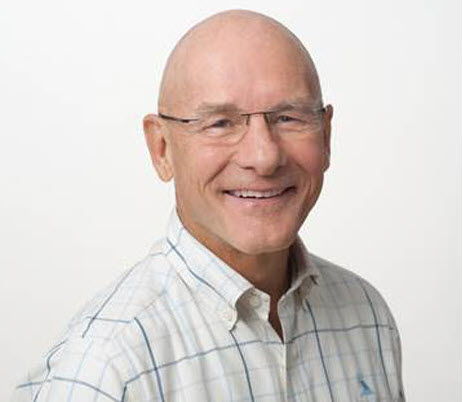
David Patterson
For pioneering a systematic, quantitative approach to the design and evaluation of computer architectures with enduring impact on the microprocessor industry.
Born in Evergreen, Illinois in 1947, David A. Patterson graduated from South High School in Torrance, California, and then enrolled at the University of California, Los Angeles (UCLA). The first person in his family to graduate from college, Patterson received his Bachelor’s(1969) and Master’s (1970) degrees in computer science. Patterson, a wrestler and math major, tried a programming course when his preferred course was cancelled (‘even with punch cards, Fortran, line printers, one-day turn-around—I was hooked”).[1]
Patterson married high school sweetheart Linda (raised near Berkeley in Albany) and with two young boys, he worked part-time (20-40 hours per week) on airborne computers at Hughes Aircraft for three years while earning a doctoral degree (1976) in computer science at UCLA. The job hooked him on practical engineering results. His thesis advisor was Gerald Estrin (also advisor for Vinton Cerf, Turing Award, 2004).
Patterson was hired into the University of California at Berkeley’s computer science/ electrical engineering department upon graduation. Patterson’s PhD thesis was on writable control store methods for operating systems, so he began his Berkeley career with Carlo Sequin working on the X-TREE project led by Alvin Despain.[2] Years later, he called this modular multiprocessor system 'way too ambitious, no resources, great fun.’ [3]
Patterson took a three-month sabbatical at Digital Equipment Corporation (1979), where Joel Emer and Douglas Clark were starting measurements on a VAX minicomputer. It had a very complex instruction set and hence a very large and complex microprogram. Patterson worked on reducing micro-coding errors, concluding that simplifying instruction sets would “easily yield reduced errors.” [4]
Back at Berkeley, Patterson and Sequin teamed on a four-course series where they tasked graduate students to investigate these ideas. Patterson coined the acronym RISC (Reduced Instruction Set Computer) to describe a resultant chip, known as RISC-1, with 44,420 transistors. A good companion computer for Berkeley’s work on UNIX operating systems and C programming techniques, it could handle large amounts of memory, and it used pipelining techniques to handle several instructions simultaneously. [5]
Instantly popular, the courses led to a Distinguished Teaching Award (1982). Patterson’s acceptance speech acknowledged why he selected Berkeley: “When I graduated from UCLA, I went around interviewing at a lot of places,…. They really said, ‘…. Teaching is something we don’t care about—the coin of the realm is publication…’. I was disturbed (because) that meant that I would be spending many hours of my life in front of a bunch of students, and if I didn’t do a good job, I’d disappoint a lot of students. If I did do a good job, I’d disappoint the people I worked for. But when I came to Berkeley, it was great. The electrical engineering/ computer science department emphasized that they really did care about teaching, ...” [6]
From 1982 to 1983, Sequin led the RISC-II chip project; Patterson managed collaboration between UC Berkeley and the ARPA VLSI program. This 40,760 transistor chip, three times faster and half the size of RISC-1, became the highly influential foundation of Sun Microsystems’ SPARC micro-architecture.
Patterson first met John Hennessy at a meeting for DARPA funded research VLSI projects in 1980 or 1981 where each was presenting their ideas. RISC-2 emerged simultaneously with Hennessy’s MIPS (Microprocessor without Interlocked Pipeline Stages) prototype at Stanford in 1983. Arguments between RISC vs. MIPS designs were soon dwarfed by their common thesis against CISC (Complex Instruction Set Computers), used by the entire industrial computer design community.
Years later, Patterson recalled: “There is this remarkable point in time when it was clear that a handful of grad students at Berkeley or Stanford could build a microprocessor that was arguably better than what industry could build—faster, cheaper, more efficient…. RISC was very controversial, it was heretical…. We had a hard time convincing people of that.” [7]
Patterson resolutely resisted the lure of leaving the university to pursue the RISC technology in a company. John Markoff, in the New YorkTimes, quoted Patterson about the chance to start a company. "I made the choice between being happy and being wealthy." [8]
Patterson and Hennessy in 1990 codified their shared insights in a very influential book, Computer Architecture: A Quantitative Approach. This book, now in its 6th edition, provided a simple, robust, and quantitative framework for evaluating integrated systems. [9]
Sun adopted the Berkeley architecture, while Silicon Graphics bought Hennessy’s MIPS. Joel Birnbaum, John Cocke’s supervisor at IBM, brought RISC ideas to Hewlett-Packard. A number of key micro-coded RISC ideas were incorporated into the Intel’s personal computer chips, and then mobile products (e.g. iPhone) emphasized efficiency, power usage, and die size. In their joint Turing Award speech at ISCA (2018), Patterson and Hennessy noted that an astounding 99% of the more than 20 billion micro-processors now produced annually are RISC processors, and are found in nearly all smartphones, tablets, and the billions of embedded devices that comprise the Internet of Things (IoT).[10]
Between 1989 and 1993, Patterson led the Redundant Arrays of Inexpensive Disks (RAID) project with Berkeley colleague Randy Katz, vastly improving speed and reliability of affordable disk systems. Most web servers now use some form of RAID; many compare this work in importance to Patterson’s RISC work. Later, Patterson contributed in implementing complex systems experiments by networking smaller computers together, foretelling “multi-tier architectures” now used by many Internet companies.
Patterson today is a Distinguished Engineer at Google and serves as Vice Chair of the Board of the RISC-V Foundation. An eternal optimist, Patterson notes that tuned hardware/software designs can offer dramatic performance improvements for deep learning applications, which he hopes will usher in a ‘new golden age of computing.’ [11]
When lecturing, Patterson frequently mentions his family, and his life-long enthusiasm for several activities, including soccer, wrestling, cycling and weight lifting. He reminds listeners that teams are better than individual activity, noting that you cannot be a winner on a losing team, while all members of a winning team are winners by definition. He worked with his high school wrestling partner, Rick Byrne, to win the American Power Lifting California championship, setting a new national record for age and weight bench press, dead lift, squat, and all three combined lifts in 2013 at age 66.[12] Patterson rode in the annual two-day Waves to Wine bike ride through the Bay Area from 2003-2012 and was the top multiple sclerosis research fundraiser for the group for seven straight years.[13]
Patterson was on the ACM Executive Council for six years, serving as ACM President, 2004-2006. He took a sabbatical year to do that, explaining that for ‘a big job’ you need really to step up to it. He also chaired the Computing Research Association, and served on PITAC for two years (Presidential Information Technology Advisory Committee). His motto throughout has been, “It’s not how many projects you start, it’s how many you finish…. So, pick one big thing a year, and finish it.” [14]
For many professional occasions in recent years, including the 2018 ACM Annual Awards Dinner, Patterson proudly has worn a Scottish kilt to honor his forebears. In his acceptance speech that evening, as well as in multiple other speeches in recent years, he cited his 50th marriage anniversary with his childhood sweetheart, Linda, who co-founded the East Bay Improv group in Berkeley many years ago. [15]
Patterson, made an ACM Fellow in 1994, is also a Fellow of AAAS and IEEE. He has been elected to the National Academies of Engineering, Sciences, and the American Academy of Arts and Sciences. Hennessy and Patterson have won a number of joint awards, including the John von Neumann Medal (IEEE, 2000), the Eckert-Mauchly ACM/IEEE award in 2001; Fellows for the Computer History Museum in 2007, and the ACM Turing Award in 2017.
Author: Charles H. House[1] Patterson, David, “Closing Remarks,” 40 Years of Patterson Symposium, UC Berkeley EE/CS, May 7, 2016; https://www.youtube.com/watch?v=8X0tsp-FVGI
[2] Carlo H. Séquin, Alvin M. Despain, David A. Patterson: Communication In X-TREE, A Modular Multiprocessor System. ACM Annual Conference (1) 1978: 194-203
[3] Patterson, David A., “Closing Remarks,” op. cit. Also see Patterson, David A., “My Last Lecture: How to be a Bad Professor,” Berkeley EE/CS, May 6, 2016; https://www.youtube.com/watch?v=TK6EPvrmcBk
[4] Patterson, David A., interview with Jim Demmel , EE/CS chair at Berkeley, UC Berkeley ACM Turing Laureate Colloquium October 10, 2018; https://eecs.berkeley.edu/turing-colloquium/schedule/patterson
[5] John Hennessy and David Patterson, “ACM A.M.Turing Award lecture, 45th ISCA (International Symposium of Computer Architecture), Los Angeles, June 4, 2018 https://www.acm.org/hennessy-patterson-turing-lecture
[6] Patterson 1982 UC Berkeley Distinguished Teaching Award lecture, published on YouTube later (March 16, 2016); https://www.youtube.com/watch?v=asKcJyFbRm0
[7] Patterson, David A., “A New Golden Age for Computer Architecture: History, Challenges, and Opportunities,” UC Berkeley ACM Turing Laureate Colloquium lecture, October 10, 2018; https://eecs.berkeley.edu/turing-colloquium/schedule/patterson
[8] Markoff, John, “Chip Technology’s Friendly Rivals,” New York Times, June 4, 1991; https://www.nytimes.com/1991/06/04/business/chip-technology-s-friendly-rivals.html
[9] J. L. Hennessy and D. A. Patterson, Computer Architecture: A Quantitative Approach, 6th ed., Computer Architecture and Design, Morgan Kaufmann Publishers, 2017
[10] John Hennessy and David Patterson, “ACM A.M.Turing Award lecture, op. cit.
[11] Patterson, David, “A New Golden Age for Computer Architecture,” Artificial Intelligence Conference, September 12, 2018 https://www.youtube.com/watch?v=c03Z0Ms8pKg
[12] Posting, Baban Zarkovich, April 20, 2013, “Professor David Patterson sets the APA RAW California State Record,” https://amplab.cs.berkeley.edu/news/professor-david-patterson-sets-the-apa-raw-california-state-record/
[13] "Berkeley's Anti-MS Crew". anti-ms-crew.berkeley.edu. http://anti-ms-crew.berkeley.edu/theteam.shtml
[14] Patterson, David A., “How to have a bad career in research/academia,” Berkeley, November 2001; https://people.eecs.berkeley.edu/~pattrsn/talks/BadCareer.pdf
[15] Patterson, “A New Golden Age” presentation; op.cit.


